The Three Stages of Hair Loss Explained
Last updated on June 24, 2026
A Practical Guide for Men and Women Noticing Hair Changes
Understanding the stages of hair loss can make it easier to recognise changes early, monitor progression and know when it may be worth seeking professional advice. Hair loss does not always happen suddenly. For some people, it begins with subtle shedding or reduced density, while others first notice changes around the hairline, crown or part line.
Men and women can move through the same broad stages of hair loss, but the visible signs are often different. Men may notice recession around the temples or thinning at the crown, while women may notice a wider part line, reduced volume or more diffuse thinning through the top of the scalp. Looking at both the stage and the pattern can give a clearer understanding of what may be happening.
Why Hair Loss Looks Different for Men and Women
Hair loss progression is not identical for everyone. In men, pattern hair loss often appears around the temples, frontal hairline and crown. The change may begin as a slightly higher hairline before becoming more obvious over time, particularly when the hair is wet, cut shorter or viewed under strong lighting.
In women, hair loss more often appears as reduced density through the top of the scalp, a widening part line or a thinner ponytail. Rather than a sharply receding hairline, the change may look more gradual or diffuse. This is why the stage of hair loss is not only about how much hair has been lost, but also where the change is happening, how quickly it is progressing and whether the thinning follows a recognisable pattern.
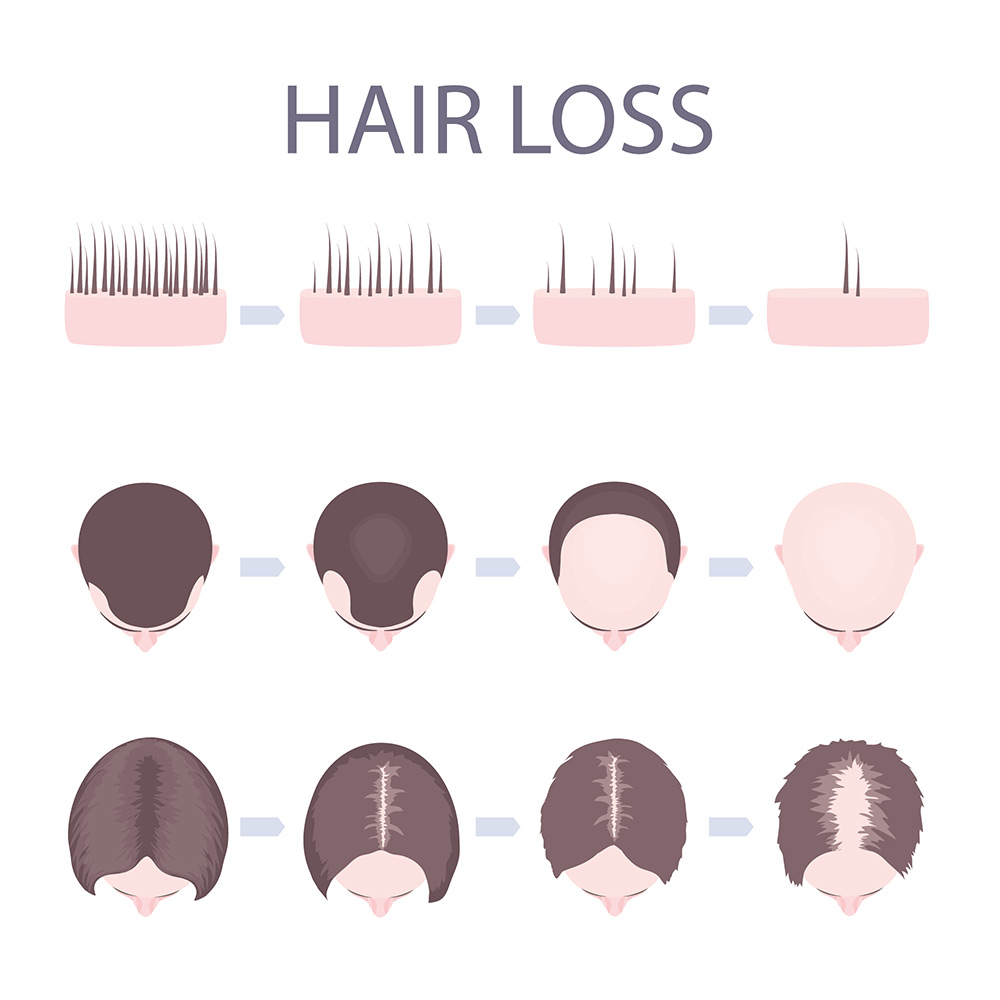
Stage 1: Early Thinning
Early thinning is the stage where changes are present but still subtle. Hair may still look reasonably full overall, but small differences begin to appear over time. The change may only be noticeable in certain lighting, in photographs or when comparing the current hairline, part line or density with older images.
In Men
For men, early thinning often starts around the temples, frontal hairline or crown. The hairline may look slightly less defined, the temples may sit a little higher, or the crown may show more scalp under bright bathroom lighting. At this stage, it can be difficult to tell whether the change is a genuine progression or simply a normal variation in styling, hair length or lighting.
In Women
For women, early thinning may appear as a slightly wider part line, reduced volume through the top of the scalp or a ponytail that feels less dense than before. Some women also notice more shedding in the shower or on a hairbrush, although shedding alone does not always mean permanent hair loss. The important question is whether the density continues to change over time.
What to Do at This Stage
At this stage, the most useful step is to observe the pattern carefully rather than panic. Taking photos every few months in similar lighting can help show whether the hairline, crown, part line or overall density is genuinely changing. It may also be worth considering recent illness, stress, hormonal changes, medication changes, diet or scalp issues, as these can all influence shedding or density.
Stage 2: Visible Progression
Visible progression is when hair loss becomes harder to dismiss. The thinning may still be moderate, but it is now more noticeable in everyday situations. Hair may not sit the same way, styling may take more effort, or certain areas of the scalp may be easier to see than before.
In Men
For men, this stage may involve clearer recession at the temples, a more noticeable change in the frontal hairline or thinning at the crown. Some men start changing their hairstyle to cover the hairline or crown, while others notice that the top of the scalp looks less dense compared with the back and sides.
In Women
For women, visible progression may appear as a wider part line, more visible scalp through the top of the head or reduced volume when the hair is tied back. Diffuse thinning can sometimes make the change harder to pinpoint, but the overall effect is often reduced density rather than one sharply defined thinning area.
What to Do at This Stage
This is often the point where assessment becomes more useful, especially if the change is continuing. The aim is not simply to name the stage, but to understand the cause, pattern and speed of progression. At Atlantis Medical, we look at how the hair is changing, whether the thinning appears localised or diffuse and whether the pattern suggests active progression or a more stable change.

Stage 3: Established Hair Loss
Established hair loss refers to more developed or longer-standing thinning. At this stage, reduced density is usually more visible, and the pattern of loss may be easier to recognise. The hair loss may be stable, slowly progressing, or still actively changing.
In Men
For men, established hair loss may involve a significantly receded hairline, broader crown thinning or reduced coverage across the top of the scalp. In more advanced cases, the stronger remaining hair is often around the back and sides. This is why assessing the donor area, scalp condition, and future pattern of loss can become important if options are being discussed.
In Women
For women, established hair loss may involve persistent thinning through the top of the scalp, a wider part that is harder to conceal or more noticeable scalp visibility in everyday lighting. Some women experience diffuse density loss rather than a clear bald patch, which means the pattern can still require careful assessment even when the thinning is visually obvious.
What to Do at This Stage
At this stage, the focus should be on getting a realistic understanding of what is happening and what may be appropriate. Hair loss that has been stable for several years may need to be approached differently from hair loss that is changing quickly. Scalp health, density, hair calibre, family history and the likely direction of future hair loss all matter when considering next steps.
When Hair Loss Should Be Assessed
Hair loss may be worth assessing if it continues for several months, progresses quickly, appears in patches, affects the hairline or crown, widens the part line, or causes uncertainty about what is happening. It may also be worth seeking advice if increased shedding follows illness, medication changes, hormonal changes or a period of significant stress.
The aim of assessment is not simply to name the stage of hair loss. It is to understand the cause, pattern and direction of change. This is especially important because early thinning, active shedding and established hair loss may need to be approached differently, even when they appear similar at first glance.
Understanding the Stage Is Only Part of the Picture
The three stages of hair loss can help make progression easier to understand. Early thinning is often subtle, visible progression is harder to ignore and established hair loss usually requires a more detailed look at density, pattern and long-term change.
If you are noticing changes in your hairline, crown, part line or overall hair density, contact Atlantis Medical to arrange a consultation. We can assess the pattern of hair loss, discuss what may be contributing to the change and help you understand which next steps may be suitable for your situation.
How to Book a Consultation
Booking your consultation is simple.
- Call us on (03) 9070 5234
- Contact us via our website
- Email us at enquiries@atlantismedical.com.au
- Or visit us at Level 2, 148 Glenferrie Road, Malvern, Vic 3144
Opening Hours
Mon – Fri: 8:30am – 5:00pm
Sat – Sun: Closed
FAQs
What are the three stages of hair loss?
The three broad stages of hair loss are early thinning, visible progression and established hair loss. These are practical categories rather than strict medical classifications, but they can help explain how hair loss may develop over time.
Are the stages of hair loss different for men and women?
The broad stages can apply to both men and women, but the visible signs often differ. Men may notice hairline recession or crown thinning, while women may notice a widening part line, reduced volume or diffuse thinning through the top of the scalp.
What is usually the first sign of hair loss?
The first sign may be a subtle change in density, increased scalp visibility, mild temple recession, a wider part line or more shedding than usual. Comparing photos over time can make early changes easier to recognise.
Does early hair loss always get worse?
Early hair loss does not always become advanced hair loss. Some shedding may be temporary, while pattern hair loss may progress gradually depending on genetics, hormones, age and other individual factors.
When should hair loss be assessed?
Hair loss may be worth assessing if it continues for several months, becomes more visible, appears suddenly, occurs in patches or affects the hairline, crown or part line. Assessment can help identify the likely cause and stage before any next steps are considered.
Any surgical or invasive procedure carries risks. Before proceeding, you should seek a second opinion from an appropriately qualified health practitioner.